Blogger templates

Friday, July 8, 2011

The Hacker Family Tree - History about Who did what to Whom


Have you been getting confused by all of the hacker groups and hacker group spinoff groups and side projects of hacker groups and their spinoffs? Are you a little tangled up in the web of connections between Anonymous, LulzSec, AntiSec and others? Don't feel bad. It's really confusing.
Thankfully, a talented intern at Geekosystem created an infographic. Describing his flowchart-like layout, Eric Limer writes, "Events are listed in unscaled but roughly chronological order from top to bottom." It's mostly helpful in seeing how the different groups are connected to each other and where they branch off on special projects. There's even some color coding and visual cues to show who's friends with whom and what those relationships begat in the recent history of hacking. There's not, however, much explanation about the projects or the groups. We've done our best to itemize and explain everything with a handy hacker glossary.
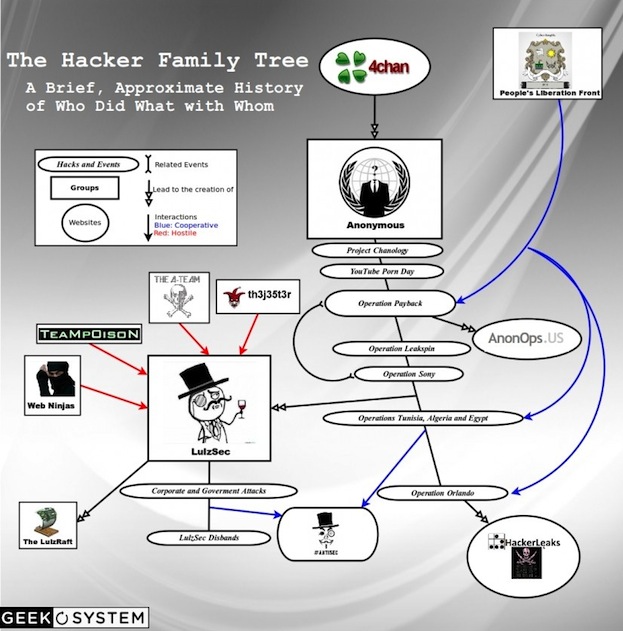
Pic via- geekosystem.com

Anonymous Branch

4chan - Christopher Poole (screenname: moot) created this anonymous, image-based forum in his New York City bedroom at age 15. Since its launch in 2003, 4chan has grown to become one of the most trafficked forums on the internet with nearly seven million unique visitors a month. The culture at 4chan is both incredibly creative--memes like lolcats and Rickrolling started on 4chan boards--as well as potentially destructive--4chan users hacked Gawker and released the account info of all their users earlier last year.
Anonymous - The name of the eponymous, leaderless hacking group originated on 4chan in 2003, and it's believed that various members of Anonymous met there. In 2008, an unofficial spokesperson Trent Peacock described the group on a Canadian Broadcasting Corporation radio show:
We [Anonymous] just happen to be a group of people on the internet who need--just kind of an outlet to do as we wish, that we wouldn't be able to do in regular society. ...That's more or less the point of it. Do as you wish. ... There's a common phrase: 'we are doing it for the lulz.'
An oft-cited mission statement of sorts reads:
Knowledge is free. We are Anonymous. We are Legion. We do not forgive. We do not forget. Expect us.
Anonymous uses the Guy Fawkes mask from V Is for Vendetta as one logo and a headless businessman for others. Beyond iconography, however, the history of Anonymous is best told through a timeline of its projects.
Project Chanology - Though the name refers to its beginnings on 4chan, Project Chanology is widely recognized as Anonymous's first major coordinated effort and targeted the Church of Scientology. Anonymous declared war on the Church of Scientology after they attempted to remove a potentially condemning video of Scientologist Tom Cruise from the internet in 2008. Though that war took many forms--prank calls, black faxes, denial-of-service attacks--it all started with this YouTube video:


The statement in the video shows off the activist beginnings Anonymous: "For the good of your followers, for the good of mankind--for the laughs--we shall expel you from the Internet and systematically dismantle the Church of Scientology in its present form."
YouTube Porn Day - After the long fought battle with the Church of Scientology and a few othersmaller projects, members of Anonymous teamed up with eBaum's World users to declare YouTube Porn Day on May 20, 2009. The protest itself, as the name sort of suggests, involved countless people uploading porn to YouTube to annoy the moderators who would then have to remove the videos. It took YouTubedays to remove all of the videos. The group repeated the action in 2010 "in protest of YouTube's decision to suspend the account of Lukeywes1234," an otherwise typical user whose account was suspended for abuse language:

Operation Payback - Anonymous did some work around the 2009 Iran election protests and Australian internet policy, but they gained global notoriety as activists--or more appropriately, "hacktivists"--for their support for WikiLeaks. Although the project started in September 2010 as a war against the recording industry for opposing internet piracy, it evolved. Beginning in late November 2010, when the first U.S. diplomatic cables were released by WikiLeaks, Anonymous latched onto the cause and launched Project Avenge Assange, an attack on banks and credit card companies who froze WikiLeaks donations.
When asked whether the attack constituted a cyberwar, security expert James Lewis balked at the term. "I would say that a war involves damage and destruction," Lewis told AFP. "This is more like a noisy political demonstration, like a mob surrounding a bank and refusing to let anyone in or out. It's not war."

AnonOps.US - This subgroup of Anonymous spun off in mid-October 2010 when Operation Payback hit a lull. They bill themselves as an infrastructure for the group, and their internet relay chat (IRC) networkremains a central hub for activity amongst various hacker group. They also maintain a Twitter accountwith updates.
Operation Leakspin - Anonymous conceived of Leakspin in December 2010 as a way to help WikiLeaks sort through data. Unlike Operation Payback, which was bent on destruction, Leakspin focused on exposing information for the public good, and the effort still survives across a number of websites.
*Attack on HB Gary - Although not mentioned in the chart, this event marks an important turning point for Anonymous. After Aaron Barr, chief executive of the internet security firm HBGary, announced that he would reveal the inner workings of Anonymous at a conference in February 2010, the group brought down their website and phones, erased files and pulled over 68,000 emails from their database. Within those documents was a PowerPoint presentation called "The WikiLeaks Threat" which HBGary compiled for Bank of America in order identify and potentially disrupt the activities of journalists who supported the movement, including Glenn Greenwald.
Operation Sony - Sony filed a lawsuit against George Hotza hacker who reverse engineered the Sony Playstation 3, in January 2011. In response, Anonymous announced that they would attack Sony's website in early April 2011. Three weeks later, the entire Playstation network was brought down, and Sony was unable to restore the network for weeks. Anonymous cheekily denied responsibility for the attack, although Sony reports having discovered a document named "Anonymous" on their servers that read "We Are Legion."
Operations Tunisia, Algeria and Egypt - During the Arab Spring, Anonymous launched a number of campaigns against the Tunisian, Algerian and Egyptian governments protesting their suspending internet access. Anonymous has also hacked into a number of Libyan government websites during the civil war there.
Operation Orlando - Anonymous attacked the websites of the Orlando Chamber of Commerce and Universal Orlando Resort in June 2011 after police there arrested Food Not Bombs volunteers for breaking city ordinances while trying to feed the homeless. HackerLeaks, a WikiLeaks-type site just for hackers, was created as a result.

LulzSec Branch

LulzSec - This small offshoot of Anonymous supposedly organized themselves around the same that Anonymous was working on various Arab Spring projects. Short for "Lulz Security" LulzSec attacked various government and corporate websites. We've covered almost all of those attacks here.
AntiSec - LulzSec disbanded in June 2011 but not before they announced a new project that reunited LulzSec members with the leaders of Anonymous. This hacktivism project began with a major release of documents from law enforcement officers in Arizona.
Web NinjasTeaMp0isoNThe A-Team and th3j35st3r ("The Jester") - These mostly small and less organized groups all launched attacks on LulzSec at some point in time. The attacks are disparate and kind of hard to track as the groups are also loosely organized. TeaMp0soiN launched this attack in late June 2011 and seem like they have a lot of members. The Jester, however, works alone.

Wednesday, July 6, 2011

Rumor: Facebook, Apple to take on Google with HTML5 platform


Project Spartan, the rumored HTML5 platform aimed at the hundreds of millions of Facebook mobile users, is being developed by Facebook and a group of 80 or so third-party app developers, who are affectionately known as Spartans. Some of those developers believe Facebook’s intentions are to break up the control Apple and Google have over the mobile app space, though Facebook of course denies this.
TechCrunch reportedly quotes two such Spartans:
I look at these apps and how content rich they are and how they have nothing to do with Apple and everything to do with Facebook and assume that they think we are retarded.
Facebook wants a cut of the Apple’s mobile app market, that’s been clear this entire time. Perhaps it’s not war against Apple — maybe Apple is just going to ‘gift’ Facebook the share of their market (the HTML5 share) in exchange an alliance being formed whereby Apple gets some exclusive access to Facebook’s 600 million-plus users and thereby cutting out Google (exclusive to some degree, Facebook is too open for it to be fully exclusive). In this theory, it’s not Facebook Spartans vs. Apple, it’s Facebook/Apple Spartans Vs Google.
Facebook is pushing to have apps on the platform, which range from games to news-reading apps, ready by July 15, 2011. The social network will reportedly make the project official sometime between then and August 1, 2011.
The above screenshot (click to enlarge) looks like a modified version of the current Facebook mobile site. Two things stand out immediately: Games and Apps, with notifications. The blue bar along the top, referred to as the chrome, binds all the different Facebook mobile sites together. These HTML5 apps will reportedly reside somewhere in the cloud and then pull in the blue chrome from Facebook so that they look like proper Facebook apps.
Facebook wants this HTML5 app platform to succeed so the mobile world is not fully controlled by Apple and Google. The company would of course also love for its own payment platform to dominate mobile by allowing developers to sell apps and offer in-app purchases with Facebook Credits.
Last month, when Project Spartan was first rumored, the first target was mobile Safari, meaning the various devices running iOS: the iPad, the iPhone, and the iPod touch. As a result, the speculation was that Facebook was eager to fight Apple, but now it’s being suggested that may not be the case, and that Google is in the crosshairs.
The broader goal is to get people using Facebook as the distribution model for apps, rather than Apple’s App Store or Google’s Android Market. Again, it’s not clear whether Facebook is siding with Apple or Google here, if either. If it’s the former though, this would be in line with another rumor from last month: Facebook Credits to work on Apple’s iTunes platform.

Tuesday, July 5, 2011

Facbook & Skype to Unleash video chat service quite Soon


HOUSTON: Just as Google's next big thing ' Google Plus' is all set to launch, Facebook and Skype are about to strike a deal that would bring the video chatting service to the social networking site. 

With Facebook CEO Mark Zuckerberg promising an "awesome" new feature on July 6, Skype, which was recently purchased by Microsoft for a whopping USD 8.5 billion, could become a fixture on the world's largest social network. 

The beta version of Google's social network, Google Plus, debuted last week to rave reviews, especially for its +Hangouts feature that allows for multi-user video chat. 

At present, Facebook users update message and status through their profile, and share photos but the addition of video chat will bring an interesting change to their account. 

Editor of Tech Crunch, Michael Arrington stated in the Next Week that Facebook, in collaboration with Skype, will unveil its video chat option which will be powered by Skype. 

This move will strengthen Facebook's position in the social networking market. 

Facebook at present is the most influential and one of the biggest social networking sites in the world having over 500 million active users. 

This isn't the first time that Skype has been linked to Facebook. 

Back in September 2010 the same rumour reared its head and this March it was reported that talks had resumed between the two companies. 

Citing an insider source, Techcrunch announced the news, describing the powered-by-Skype Facebook video chat: "The product has been built on Skype and will include a desktop component". 

"It's not clear to me whether that means it will just work if a user has Skype already installed on the computer, or if additional software will need to be downloaded even if the user already uses Skype. 

"But it's clear that there's very deep integration between the products, and from the user's perspective, the product will be an in browser experience". 

Official word will come out tomorrow when Facebook holds an event at its Palo Alto headquarters.
Via- Indiatimes

Monday, July 4, 2011

Facebook CEO says company will ‘Launch Something Awesome’ next week


Speaking to reporters on Thursday, Facebook’s CEO Mark Zuckerberg said that the social network has plans to “launch something awesome” next week. There’s no official word on what will be announced, but we suspect it’s going to be the new iPhone photo-sharing service that we saw just last week. The service — which looked amazing in the leaked screen shots — will likely compete with other applications such as Instagram and Path. Rumor has it that inside Facebook headquarters, the new photo sharing app has been dubbed either “WithPeople,” or “Hovertown.” It’s entirely possible that Zuckerberg will also take the wraps off of his company’s native Facebook iPad app, since it would likely fit well into the photo-sharing ecosystem. Lastly, it’s possible Facebook will detail the next steps it’s taking with its Facebook Places check-in service, too, but given Zuckerberg’s use of the word “launch,” we’re not so sure. It remains unclear what day the announcement will be made.

Saturday, July 2, 2011

GoDaddy, an Internet Domain Registrar sold for $2.25 Billion


SAN FRANCISCO (AP) — The parent company of GoDaddy.com, a top registrar of Internet domain names, has been sold to a group of private investment firms for $2.25 billion, a person familiar with the transaction told The Associated Press.
Go Daddy Group Inc.'s sale to KKR, Silver Lake and Technology Crossover Ventures comes as the company expects to top $1.1 billion in revenue this year because expanding Internet use has fueled the creation of more websites and the "domains" needed to help find them. Go Daddy announced the sale late Friday. A person close to the transaction, who asked to remain anonymous because of not being authorized to speak publicly, told the AP the sale price.
A fact sheet accompanying the release indicated that Go Daddy's revenue has grown by more than 20 percent in each of the past several years.
The Go Daddy Group Inc. was founded in 1997 by Bob Parsons, who continues to serve as its CEO. The company, based in Scottsdale, Ariz., manages more than 48 million domain names, and sells other Internet-related technologies.  By JORDAN ROBERTSON, AP Technology Writer

Facebook Hires Sony's PS3 Hacker

New York - The 21-year-old computer whiz whose legal tussle with Sony triggered one of the largest assaults by the hacker community on a single company has found himself a steady job - with Facebook. George Hotz became a star among hackers under the internet pseudonym name GeoHot when he “unlocked” Apple's iPhone and then the Sony PlayStation games console. He posted details of how to alter software on the devices so that tech-savvy users could use them for unauthorised games and other applications.


Facebook swooped to hire Mr Hotz last month, just weeks after he settled the lawsuit from Sony that so enraged fellow hackers that they launched an attack on the company that has cost it tens of millions of dollars to date.


The social networking giant has not said what Mr Hotz will be working on, though there was speculation he could be involved in building anti-hacker defences at Facebook, or in the company's plans to develop a rival to Apple's App Store for software downloads.


Mr Hotz is straight out of hacker central casting, a teenage computer genius who grew up in New Jersey and was identified early as a talented youngster, attending a special programme for bright children from the US state school system. He led his school in national robot-building championships and appeared on national television demonstrating his creations.


It was in 2008 that he achieved fame in the hacker community for conducting the first so-called “jailbreak” of an Apple iPhone. His hack allowed users to get round Apple's tight controls on what apps can be downloaded to the phone and which mobile phone networks it can be used on.


And then in 2009 and 2010, he chronicled on his blog his attempts to similarly unlock Sony's PlayStation 3 console, and earlier this year he posted “root keys” for the PS3 so that others could emulate his work and build homegrown software on the device. Sony launched a lawsuit days later, saying Mr Hotz was encouraging the use of pirated games.


In an interview on the cable TV channel G4, Mr Hotz put himself in the tradition of radio hams of old and said he was fighting for the right for computer fans to tinker with their equipment. “This is about a lot more than what I did and me,” he said of the lawsuit. “It's about whether you really own that device that you purchase.”


Facebook's decision to hire Mr Hotz sends a powerful signal that it will be a welcoming employer for the brightest engineers. Google bosses last year said they were in a “war for talent” with Facebook and other Silicon Valley firms, and the war is only likely to hot up now that money is flowing into the technology industry from investors keen to find the next Facebook.


As Mr Hotz was yesterday ensconced in his new role, the fallout from his actions continued to reverberate. Sir Howard Stringer, the British businessman who runs Sony, faced calls for his resignation at the Japanese firm's annual shareholder meeting.


The company was forced to temporarily shut down its PlayStation Network of online games after disclosing in April that hackers had accessed personal information on 77 million of its customers, potentially including their credit card details.


Sir Howard said on Tuesday that the company had been the victim of a revenge attack by supporters of Mr Hotz. “We believe that we first became the subject of attack because we tried to protect our intellectual property, our content, in this case videogames,” he said. - The Independent

Friday, July 1, 2011

Google`s New social network Google+

Google Inc is making its boldest move to take on Facebook in the fast-growing social networking market and to maintain its dominance on the Web.


Google, which has been frustrated by a string of failed attempts to crack the social networking market, introduced a full-fledged social network on Tuesday dubbed Google+ (plus.google.com). It is the company's biggest foray into social networking since co-founder Larry Page took over as chief executive in April.


Page has made social networking a top priority at the world's No. 1 Internet search engine, whose position as the main gateway to online information could be at risk as people spend more time on sites like Facebook and Twitter.


Google+ (Google Plus), now available for testing, is structured in remarkably similar fashion to Facebook, with profile pictures and newsfeeds forming a central core. However, a user's friends or contacts are grouped into very specific circles of their choosing, versus the common pool of friends typical on Facebook.
To set its service apart from Facebook, Google is betting on what it says is a better approach to privacy - a hot-button issue that has burned Facebook, as well as Google, in the past.


Central to Google+ are the circles of friends and acquaintances. Users can organize contacts into different customized circles - family members, coworkers, college friends - and share photos, videos or other information only within those groups.


In the online world there's this 'share box' and you type into it and you have no idea who is going to get that, or where it's going to land, or how it's going to embarrass you six months from now, said Google Vice President of Product Management Bradley Horowitz.


For us, privacy isn't buried six panels deep, he added.
Google+ started rolling out to a limited number of users on Tuesday in what the company is calling a field trial. Only those invited to join will initially be able to use the service. Google did not say when it would be more widely available.


Google, which generated roughly $29 billion in revenue in 2010, said the new service does not currently feature advertising.
Enticing consumers to join another social networking service will not be easy, said Rory Maher, an analyst with Hudson Square Research.


They're going to have an uphill battle due to Facebook's network effects," said Maher, citing the 700 million users that some research firms say are currently on Facebook's service.


The more users they (Facebook) get, the harder it gets for Google to steal those,he said. But he added that Google's popularity in Web search and email could help it gain a following.


WHAT'S YOUR REACTION?

addthis

Twitter Delicious Facebook Digg Stumbleupon Favorites More